
The Complete Guide to Website Design for Nigerian Businesses
In today’s digital economy, having a professional website is no longer a luxury for large corporations like Dangote Group or GTBank; it is a necessity for every Nigerian business, from a boutique in Yaba to a fintech startup in Yabacon Valley. This is The Complete Guide to Website Design for Nigerian Businesses.
This guide covers everything you need to know about website design for Nigerian businesses: costs, domain names, mobile optimisation, local payment integrations, and SEO. Bookmark it; you will refer back to it.
Why Every Nigerian Business Needs a Website
Many small business owners in Nigeria rely on Instagram, WhatsApp, or Facebook. Social media is powerful, but it is not enough. Here is why a dedicated website is essential for your Nigerian business:
- Credibility and trust. A professional website signals legitimacy to sceptical Nigerian consumers. It shows you are not a “hit-and-run” seller.
- You own the platform. Social media algorithms change. Accounts get hacked or banned. A website is a digital asset you fully control.
- Wider reach via Google Search. When customers search “best caterers in Lagos” or “affordable plumber in Abuja,” a website makes you findable.
- 24/7 sales and bookings. Your physical shop closes at 9 PM; your website stays open to accept orders while you sleep.
- Competitive advantage. Fewer than 30% of Nigerian SMEs have functional websites — building one now puts you ahead.
Step 1: Define the Purpose of Your Website
Before contacting a web designer or signing up for a website builder, define exactly what your website needs to do. This one step saves money and avoids expensive redesigns later.
Nigerian SMEs typically need one of three types:
Brochure Website (Informational)
Acts as an online flyer: who you are, what you offer, how to contact you. Best for consultants, law firms, clinics, and restaurants.
E-Commerce Website
Lets customers browse products and pay online. Best for fashion retailers, electronics stores, and grocery delivery services.
Portfolio Website
Showcases your work visually. Best for photographers, architects, and creative agencies.
Step 2: Choose a Domain Name and Hosting
.com vs. .com.ng — Which Domain is Right for You?
Your domain name is your online address (e.g., yourbusiness.com or yourbusiness.com.ng).
- .com — the global standard. Best if your audience includes the diaspora or international clients. Popular names are often taken.
- .com.ng or .ng — signals local identity. Builds trust with Nigerian customers and is usually cheaper and easier to secure.
⚠ SEO Tip: Include your primary keyword or business category in your domain name where natural (e.g., lagosbakers.com.ng). Avoid hyphens and numbers.
Web Hosting: Local vs. International
Hosting is where your website files live. Your choice affects speed, support, and cost:
- International hosts (Bluehost, SiteGround) — reliable, good for diaspora-facing businesses. Payments in USD.
- Local Nigerian hosts (Geeksvillage) — pay in Naira, local support. Check uptime guarantees before committing.
⚠ SEO Tip: Hosting server location affects page speed, which is a Google ranking factor. Choose a host with servers close to your target audience.
Step 3: Design for the Nigerian User Experience
Design is not only about aesthetics — it is about performance. The golden rule for website design in Nigeria: **mobile-first, data-friendly.**
Mobile-First Is Non-Negotiable
Over 80% of internet traffic in Nigeria comes from mobile phones — including budget Tecno and Itel devices. Your website must be fully responsive, meaning it adapts automatically to any screen size. If it only looks good on a laptop, you are losing the majority of your potential customers.
Speed and Data Optimisation
Millions of Nigerians browse on limited MTN, Airtel, or Glo data plans. Heavy, uncompressed images (such as 5MB product photos) will cause visitors to leave before your page even loads.
- Compress all images before uploading (use tools like TinyPNG or Squoosh).
- Avoid heavy animations and video autoplay.
- Aim for a page load time under 3 seconds.
- Use a Content Delivery Network (CDN) to serve files faster.
⚠ SEO Tip: Google’s Core Web Vitals (speed, interactivity, visual stability) are direct ranking factors. A fast Nigerian website ranks higher in local search results.
Trust Signals That Convert Nigerian Visitors
Because online fraud is a real concern in Nigeria, your design must proactively build trust:
- Display a verifiable phone number and physical address prominently.
- Include an ‘About Us’ page with real photos of your team or office.
- Show client testimonials, case studies, or Google reviews.
- Display security badges (SSL padlock, payment provider logos).
Step 4: Essential Features for Nigerian Businesses
1. Nigerian Payment Gateway Integration
If you sell online, integrate a trusted local payment gateway. Never ask customers to transfer to a personal bank account — it looks unprofessional and reduces conversion rates.
- Paystack — the most popular choice; easy to integrate and widely trusted.
- Flutterwave — ideal for businesses accepting international payments.
- Remita — suitable for government-facing or enterprise transactions.
2. WhatsApp Click-to-Chat Button
WhatsApp is Nigeria’s dominant customer service channel. Add a floating “Chat on WhatsApp” button to every page. This single feature can increase customer enquiries by over 40%.
3. Local SEO Optimisation
Search engine optimisation (SEO) helps Nigerians find your business on Google. Key actions:
- Use location-specific keywords (e.g., “office furniture Lagos” instead of just “office furniture”).
- Register on Google Business Profile to appear in Google Maps results — critical for restaurants, mechanics, clinics, and retail shops.
- Write a blog targeting questions your customers search for (e.g., “how to choose a caterer in Lagos”).
- Ensure every page has a unique meta title and meta description.
- Use descriptive alt text on all images, including location keywords where relevant.
4. Clear Call-to-Action (CTA) on Every Page
Every page should guide the visitor toward one action: Call now, Order online, Book a consultation, or Get a quote. Unclear CTAs are the biggest conversion killer on Nigerian business websites.
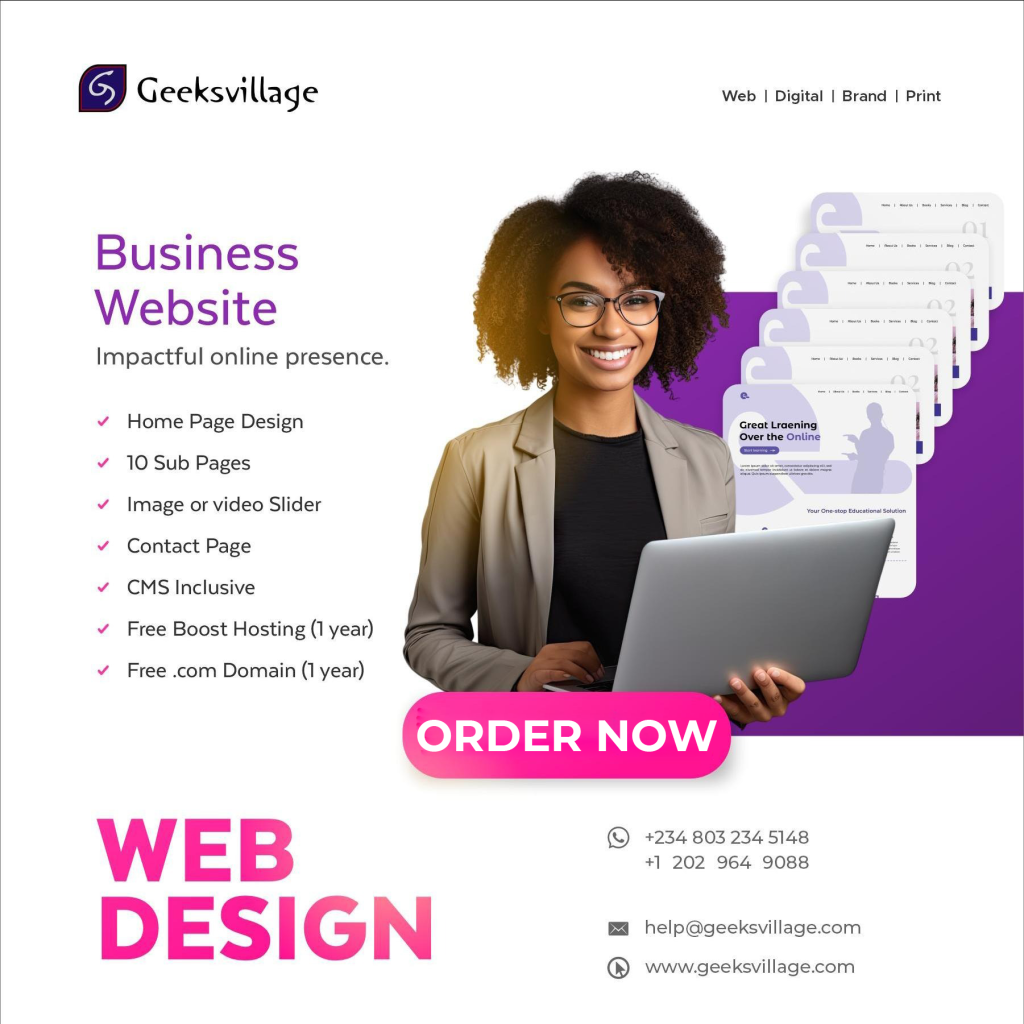
Step 5: How Much Does a Website Cost in Nigeria? (2025 Prices)
Pricing varies by complexity and who builds it. Here is a realistic breakdown, excluding annual domain and hosting fees:
Freelancer
- Brochure site: ₦100,000 – ₦250,000
- E-commerce site: ₦300,000 – ₦600,000
- Pros: Affordable. Cons: Risk of slow delivery, poor communication, or being abandoned after handover.
Professional Agency
- Brochure site: ₦250,000 – ₦1,000,000
- E-commerce site: ₦500,000 – ₦1,000,000+
- Pros: Professional design, ongoing support, formal contract, and security. Cons: Higher upfront cost.
DIY Website Builders
- Platforms: WordPress (with Elementor), Wix, or Squarespace.
- Cost: Minimal — mainly your time plus premium theme/plugin costs.
⚠ Avoid free website plans. They display third-party ads on your pages, undermine your credibility, and severely limit SEO performance.
Step 6: Website Maintenance — Your Ongoing Responsibility
A website is like a vehicle: you cannot buy it and never service it. Neglected websites lose traffic, get hacked, and break over time.
- Security updates. Update plugins, themes, and your CMS regularly to close vulnerabilities.
- Content freshness. Google rewards websites that publish new content. A blog or updated product catalogue signals an active business.
- Weekly backups. Back up your site to cloud storage (Google Drive or Dropbox) to prevent total data loss if the server fails.
- Performance monitoring. Use Google Search Console (free) to track keyword rankings and identify technical errors.
- SSL certificate renewal. Ensure your SSL certificate stays active — an expired certificate triggers a “Not Secure” warning that drives visitors away and hurts SEO.
Start Building Your Digital Office Today
Website design for your Nigerian business is an investment, not an expense. It bridges the gap between your business and the millions of Nigerians searching Google for services every day.
Whether you hire a professional agency, work with a freelancer, or build it yourself, keep these three priorities front of mind: **speed, mobile usability, and trust.** Get those right, and your website will work for your business around the clock.
Why You Need A Website For Your Small BusinessOWNING A BLOG A NECESSITY OR NOT A QUESTION AND ANSWER FROM A BLOGGER VIEW (1)???User Review
( votes)
HOW TO MANAGE CASH FLOW IN BUSINESS

The Adoption of Sustainable Practices in Small-Scale Enterprises

How You Can Improve Your Marketing Strategy on Any Budget
About Author